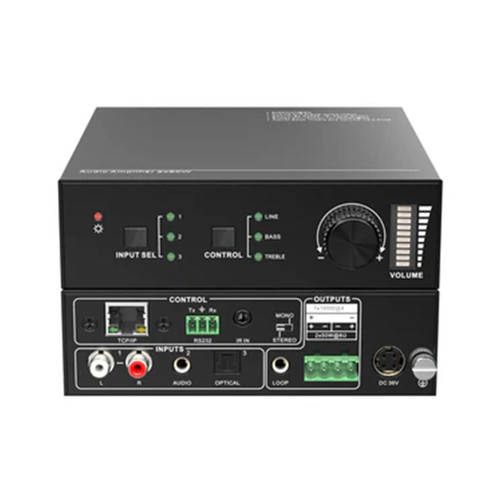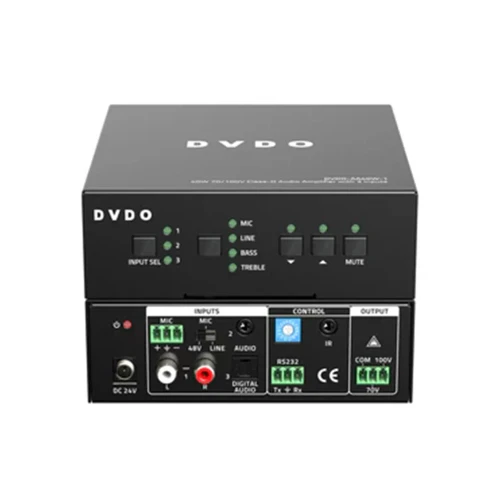






This DVDO AA2x20W-1 2x20W Class-D Audio Amplifier with 3 Inputs is a compact Class D stereo audio amplifier ideal for small to medium-sized AV environments, including classrooms, meeting rooms, small venues, bars, restaurants, and digital signage systems.
It offers two analog audio inputs (1 x stereo RCA and 1 x 3.5mm) plus a microphone input with switchable 48V phantom power and an integrated mixer function.
The amplifier supports three output configurations: Stereo (2x20W @ 4Ω), Mono, and Bridge (1x40W @ 8Ω), with adjustable bass, treble, volume and input selection controls.
Operation is flexible, with control options via front panel buttons, IR remote or RS-232.
DVDO AA2x20W-1 2x20W Class-D Audio Amplifier with 3 Inputs Features:
- High-efficiency Class D amplification with low heat generation and reliable operation
- Compact design suitable for rack, wall, ceiling or under-table mounting
- Two analog audio + one microphone switchable inputs with mixer function
- Balanced/unbalanced MIC input supports 48V phantom power, dynamic and wireless microphones
- Switchable output modes: Stereo 2x20W @ 4Ohm (default), Dual Mono or Bridge 1x40W @ 8Ohm
- Loop output for signal pass-through or daisy-chaining
- Noise gate: automatically mutes the output when no input signal
- Independent volume, bass and treble control
- Control via front panel buttons, IR & RS232
Why not buy this DVDO AA2x20W-1 2x20W Class-D Audio Amplifier with 3 Inputs today?
HDTV Supply partners with DVDO to sell and support all DVDO products
Why not buy this DVDO AA2x20W-1 2x20W Class-D Audio Amplifier with 3 Inputs today?
How does the bridge connection change the amplifier output?
A: Bridge connection sums left and right inputs to a single mono output and raises the available power to 1x40W at 8Ω.
What speaker impedances are supported for stereo and bridged modes?
A: Stereo mode expects 4Ω loads (2x20W), and bridged mode is specified at 8Ω (1x40W).
Is there a line-level loop output for daisy-chaining or recording?
A: Yes — the unit provides a line audio output on a 3.5mm jack for loop-through or daisy-chaining.
Does the amplifier include a noise gate that mutes when no signal is present?
A: Yes — it has an automatic noise gate that mutes the output when there is no input signal.
What microphone input types and wiring options are supported?
A: The MIC input accepts balanced and unbalanced connections and supports three modes: 48V phantom (for condenser mics), MIC (dynamic), and LINE (for line-level or wireless outputs) with specified +, -, and ground wiring.
Can the MIC input provide 48V phantom power and when should it be used?
A: Yes — the MIC input can supply 48V phantom power and it should be used for condenser microphones only.
What RS232 commands control volume, EQ and status checks?
A: RS232 commands include numeric codes to raise/lower MIC and line volume, change bass/treble, preset levels, and a 600% command to request the unit's working status.
Will powering multiple units at once risk overloading the circuit?
A: The manual states the amplifier has ultra-low inrush current so multiple units can be powered on simultaneously without overloading power circuits.
How do I check the amplifier’s current working status remotely via RS232?
A: Send the RS232 command 600% to request the working status; the unit will return status lines such as volume, bass and treble.