






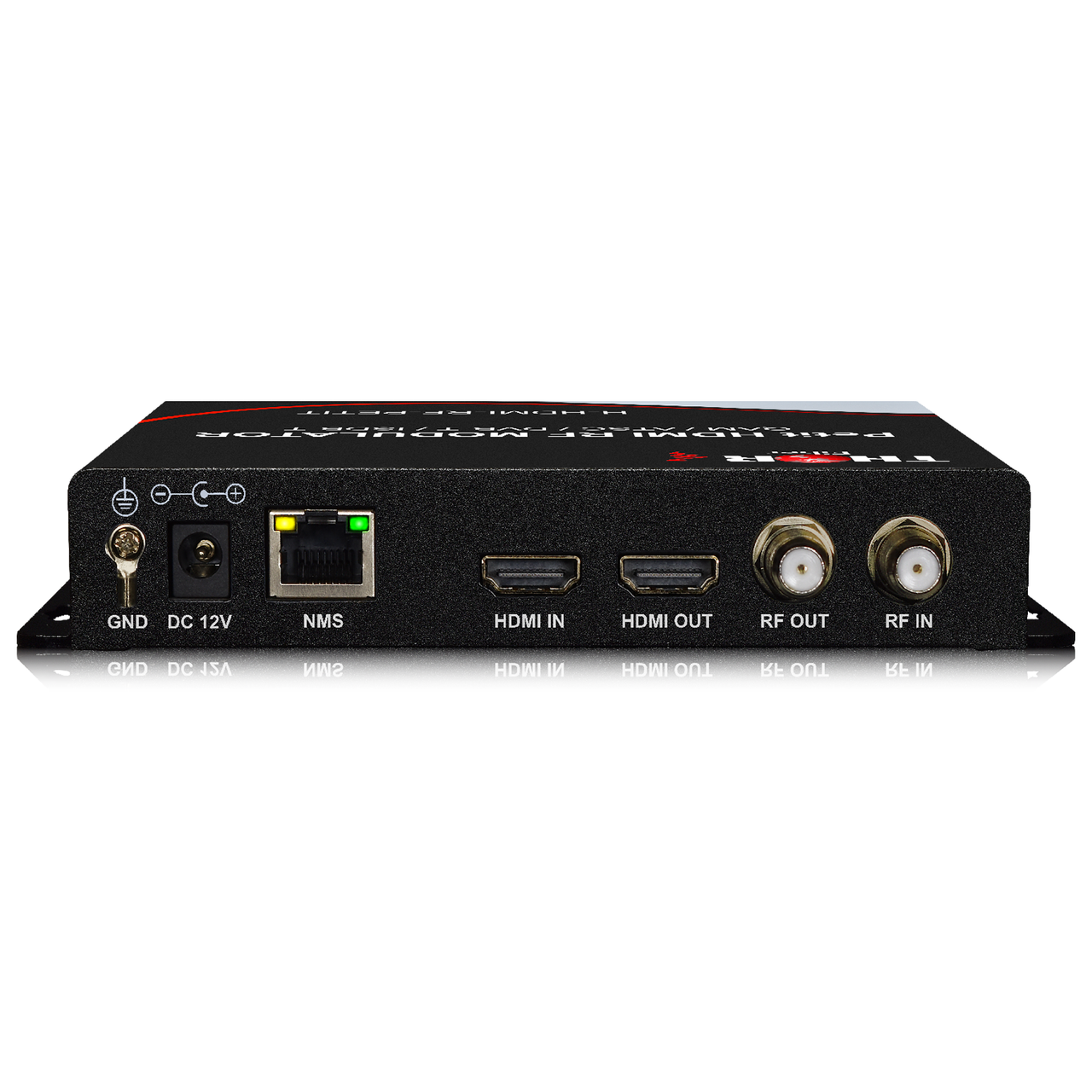
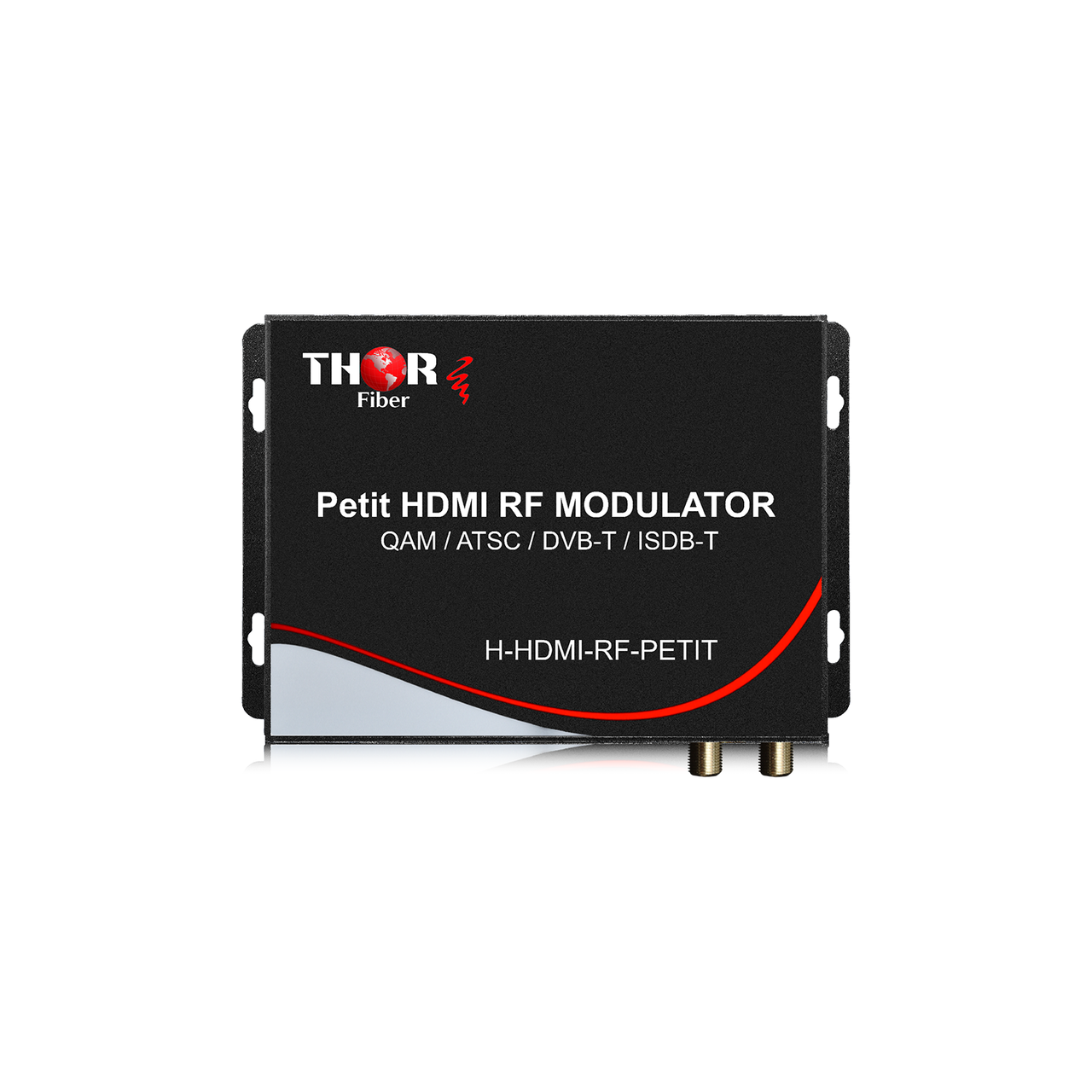


The Thor Broadcast H-HDMI-RF-PETIT HDMI RF Modulator, purchased from HDTV Supply, is your ultimate all-in-one solution for transforming any HDMI source—such as a set-top box, satellite receiver, HDMI camera, DVD player, computer, or ROKU—into a high-quality RF TV channel of your choice.
This compact yet powerful device features HD MPEG2 encoding with AC3 Dolby Audio, delivering crisp, professional-grade output in DVB-C, DVB-T, ATSC, or ISDB-T formats. It supports HD video resolutions of 720p, 1080i, and 1080p, ensuring compatibility with virtually any modern source.
Engineered for plug-and-play simplicity, it offers exceptional broadcast quality at an affordable price—ideal for users looking to distribute content to thousands of televisions simultaneously, without breaking the bank. Control is effortless via Thor Broadcast’s proprietary GUI, widely praised as one of the most intuitive interfaces in the industry.
Thor Broadcast H-HDMI-RF-PETIT HDMI RF Modulator Features:
- HDMI Input - HDCP compliant ( works with any HDMI device )
- 10/100 Ethernet NMS port for control, setup, and monitoring
- RF output could be set to any CATV format as QAM, ATSC, DVB-T, or ISDB-T
- RF output power is +24dbmv; enough for distributing HDTV video to 100's TV over existing coax cable network
- RF power could be controlled over the network via NMS Gui (Proprietary)
- MPEG2 video encoding
- AC3 Audio encoding
- Video bit rate 1-19.5Mbps can managed over the network
- Supports any CATV RF agile channels form 57-1000Mhz, channels 2 -135,
- Supports output resolutions up to 1080p
- Easy to set up via NMS.
- Small size and light weight
- Includes wall-mount type rack ears
- Install multiple units onto your TV system
Why not buy this Thor Broadcast H-HDMI-RF-PETIT HDMI RF Modulator today?
Thor Broadcast H-HDMI-RF-PETIT HDMI RF Modulator Specification:
|
Encoding Section-Video |
|||||
|
Encoding |
MPEG2 |
||||
|
Interface |
HDMI*1 |
||||
|
Resolution |
Input |
Output |
|||
|
720@60p |
Max. 1080@30p |
||||
|
1080@50i |
|||||
|
1080@60p |
|||||
|
Bit rate |
2.000-24.000 Kbps |
||||
|
Encoding Section-Audio |
|||||
|
Encoding |
MPEG-1 Layer2, MPEG-2 AAC, AC3 |
||||
|
Sample rate |
48KHz |
||||
|
Bit rate |
MPEG1 Layer 2 (128Kbps) |
||||
|
MPEG-2 AAC (VBR) |
|||||
|
AC3 (128kbps) |
|||||
|
System |
|||||
|
Management |
Ethernet |
||||
|
Language |
English |
||||
|
Upgrade |
USB/Ethernet |
||||
|
Menu Configuration |
|||||
|
Basic |
RF range/Key ID/ Service Name/ RF attenuation |
||||
|
Advanced |
Service provider/Network ID/ ONID/ TS ID/ Service |
||||
|
ID/PMT PID/VPID/APID/PCR PID/Network |
|||||
Why not buy this Thor Broadcast H-HDMI-RF-PETIT Petit HDMI RF Modulator today?
Thor Broadcast & Thor Fiber Short Form Catalog 2019
Thor Broadcast H-HDMI-RF-PETIT User Manual
How to Connect HDMI RF Petit to PC Via Ethernet
Why not buy this Thor Broadcast H-HDMI-RF-PETIT HDMI RF Modulator today?
What HDMI input connections and HDCP support does the H-HDMI-RF-PETIT provide?
A: The H-HDMI-RF-PETIT has one HDMI input, documented as HDCP compliant. Supported source examples include set-top boxes, satellite receivers, HDMI cameras, DVD players, computers, and Roku devices.
Which RF formats can I use, and what must the receiving TVs support?
A: The RF output can be configured for QAM/DVB-C, ATSC, DVB-T, or ISDB-T. Choose a format compatible with the receiving TVs' tuners; the available output formats do not mean every television can receive every format.
What video and audio encoding formats are available?
A: Video is encoded using MPEG2. The audio specifications list MPEG-1 Layer 2, MPEG-2 AAC, and AC3 at a 48 kHz sample rate, with 128 kbps listed for MPEG-1 Layer 2 and AC3 and variable bitrate for AAC.
How is the modulator configured and monitored?
A: A 10/100 Ethernet NMS port provides setup, control, and monitoring through Thor Broadcast's proprietary PC GUI. Network controls include RF power adjustment, and firmware upgrades are supported through USB or Ethernet.
Which channel identification and transport-stream settings can be configured?
A: Configuration options include the service name, service provider, Network ID, ONID, Transport Stream ID, and Service ID. Advanced settings also include PMT PID, video PID, audio PID, and PCR PID for coordinating the service within an RF distribution system.
How should I choose coax cable and estimate distribution distance?
A: Use a signal-loss budget rather than assuming a fixed maximum cable distance. For example, the supplied attenuation chart lists losses at 550 MHz of 5.9 dB per 100 feet for RG-59, 4.71 dB for RG-6, and 2.94 dB for RG-11. Include cable length, splitters, connectors, and splices when evaluating the distribution network.
Can multiple H-HDMI-RF-PETIT units be used in one TV distribution system?
A: Yes, multiple units can be installed in the same TV system. Each unit accepts one HDMI input, so a multi-source installation can use multiple modulators with coordinated RF channel assignments and a suitable coax combining network.
What power supply rating is specified?
A: The power supply rating is 12 V, 1 A. The H-PS-12X16, a 16-port 12 V, 1.5 A DC rackmount power supply, is an optional accessory.
Can I reuse an existing coax TV network to distribute an HDMI source?
A: Yes. The H-HDMI-RF-PETIT converts an HDMI source into a digital RF TV channel for distribution over an existing coax network. This supports shared viewing without requiring a separate HDMI cable run to every television, provided the TVs support the selected RF format and the coax network has an adequate signal-loss budget.
Can I show an HDMI camera feed on televisions throughout a building?
A: Yes, an HDMI camera is one of the documented source types. Its audio/video signal can be converted into an RF channel and distributed through the building's coax TV system to compatible televisions.
Can one satellite receiver or set-top box supply the same program to many TVs?
A: Yes. A satellite receiver or set-top box can feed the HDMI input, and the modulator can distribute that source as a shared RF channel to multiple televisions. This is a shared-program arrangement: the distributed channel carries the content selected at the source receiver.


