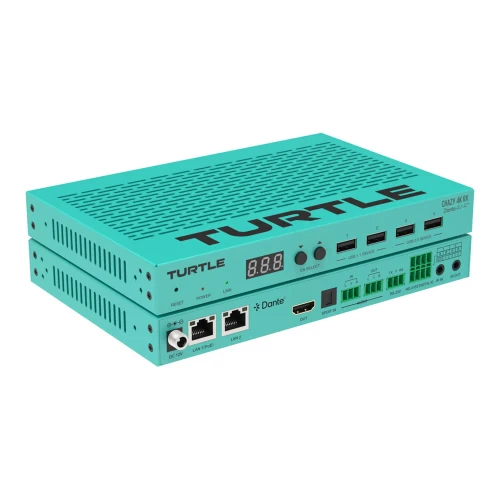



This Turtle AV TAV-CHAZY4K-TX Chazy 4K TX Dante AV-A HDMI Encoder features HDMI input and output ports, L/R audio input and output, and an SPDIF output, all of which support up to UHD 4K60 video and 7.1 Dolby Atomos audio, among other audio protocols.
The included Dante AV-A license comes with the encoder, as well as a 2 x 2 Dante audio license.
Dual network ports keep AV and control signals separated. Power is delivered to the unit via PoE or DC input.
TAA Compliant: Turtle AV products, sold by HDTV Supply, and sold in the USA are TAA compliant, meeting U.S. government standards for procurement.
This ensures they can be confidently used in federal contracts, adhering to strict ethical sourcing and manufacturing regulations.
Turtle AV TAV-CHAZY4K-TX Chazy 4K TX Dante AV-A HDMI Encoder Features:
- KVM support
- USB-B host port, USB-A device ports
- 1 Gb/s Network bandwidth, 480 Mb/s USB bandwidth
- Video wall configurations up to 9 x 9
- Hardware scaling
- EDID management
- HCDP 2.2 compliance
- Multicast support
- TAA compliant
Why not buy this Turtle AV TAV-CHAZY4K-TX Chazy 4K TX Dante AV-A HDMI Encoder from HDTV Supply today?
What is the Turtle AV TAV-CHAZY4K-TX?
A: The Turtle AV TAV-CHAZY4K-TX is a Chazy 4K TX Dante AV-A HDMI encoder designed to place an HDMI video source onto a networked AV system.
It converts the source-side HDMI signal into a compatible Dante AV-A network stream for distribution to compatible Chazy receivers and other supported endpoints.
What video source does the Chazy 4K TX accept?
A: The transmitter is designed around an HDMI video input for compatible source equipment.
It can therefore be used with computers, media players, cameras, presentation equipment, and other HDMI sources that operate within the encoder's supported video formats.
What is Dante AV-A?
A: Dante AV-A is a networked AV transport technology that allows compatible video and audio signals to be distributed over Ethernet.
Using a common network infrastructure can make it easier to route sources to multiple endpoints compared with fixed point-to-point cabling.
Does the Chazy 4K TX support 4K video?
A: Yes, the product is part of the Chazy 4K family and is designed for 4K-class HDMI encoding.
The actual resolution and frame rate depend on the source signal and the supported capabilities of the complete Chazy AV-A system.
Can the encoder be used with Dante audio systems?
A: The Chazy platform uses Dante AV-A networking, allowing compatible audio and video workflows to coexist within a networked AV environment.
This can be useful when video distribution and Dante audio routing are required as part of the same professional AV installation.
Can multiple receivers access an encoded source?
A: A network encoder is intended to make a source available to compatible network destinations rather than limiting it to a single directly connected display.
The exact routing behavior depends on the network configuration and the control and receiver devices used in the Chazy system.
What network connection is used?
A: The encoder connects to the AV network using Ethernet infrastructure appropriate for the Dante AV-A system.
Network switches should be selected and configured to handle the required AV traffic, including bandwidth and multicast requirements where applicable.
Is HDCP supported?
A: HDMI source compatibility includes the relevant content-protection requirements supported by the encoder and connected endpoints.
For protected content, the source, encoder, network path, decoder, and display must all support the required HDCP version and content-protection behavior.
Can the Chazy 4K TX be centrally managed?
A: The Chazy family can be deployed with compatible central management and control components.
Centralized control is useful for configuring and operating multiple encoders and receivers in larger networked AV installations.
Where is the Chazy 4K TX commonly used?
A: Typical applications include corporate AV, education, digital signage, control rooms, conference facilities, and distributed video systems.
Its network-based architecture is useful when an HDMI source needs to be distributed across multiple locations without running dedicated HDMI cables to every display.