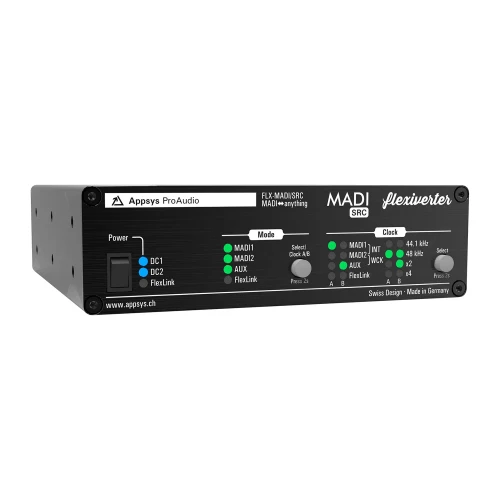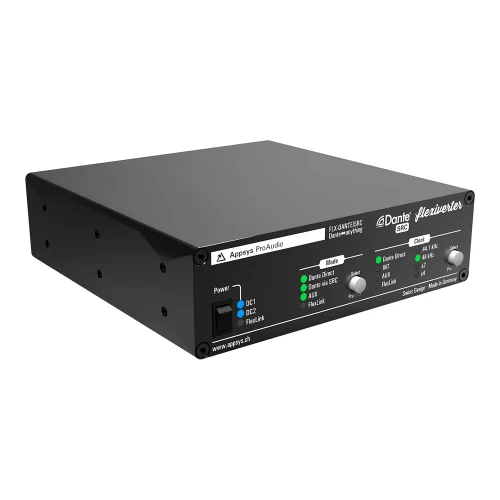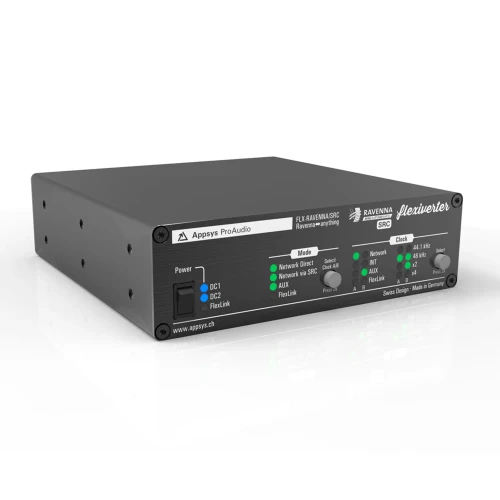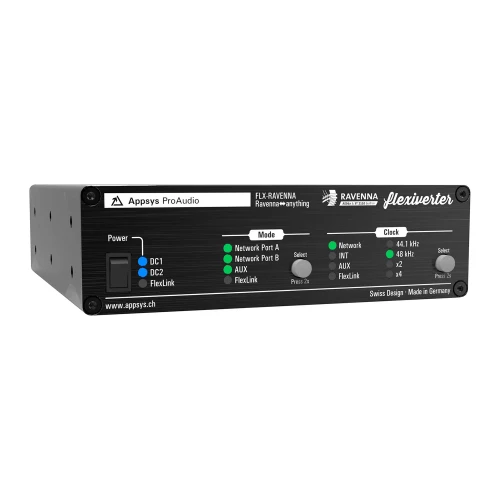



This Appsys ProAudio FLX-MADI/SRC-COAX 2x2 MADI-to-Anything Converter with Built-In 64x64ch Sample Rate Converter is a compact, high-performance solution for integrating MADI coaxial signals into virtually any audio network.
Designed for maximum flexibility, it converts MADI to any protocol via the AUX slot and back again, while incorporating a powerful 64x64-channel sample rate converter for seamless operation across complex systems.
Whether used as a standalone converter or as part of a larger Flexiverter ecosystem, the FLX-MADI/SRC-COAX delivers precise, reliable audio transport with exceptional sonic performance.
Flexible MADI-to-Anything Conversion: The FLX-MADI/SRC-COAX converts up to 64x64 channels of MADI audio, even at 96 kHz, to any protocol supported by an installed AUX card.
The AUX port enables seamless integration with a wide range of formats, allowing the unit to adapt to evolving workflows.
For expanded systems, both the internal channels and those from the AUX card are available via the FlexLink port, making it an ideal extension for the MVR-mkII or other Flexiverter devices.
Integrated High-Performance Sample Rate Conversion: A built-in 64x64-channel bidirectional sample rate converter ensures smooth interoperability between systems operating at different clock domains.
With specifications exceeding 120 dB THD+N and 134 dB dynamic range, it maintains audio integrity across conversions.
The SRC can also be bypassed when not required, providing additional flexibility for optimized signal paths.
Comprehensive Connectivity and Clocking: The unit features dual MADI coaxial ports with two inputs and two outputs, along with dedicated wordclock input and output for precise synchronization.
When paired with compatible AUX cards such as AUX-MADI-COAX-DUAL or AUX-MADI-SFP-DUAL, the converter can function as a MADI-to-MADI bridge with full network and clock domain separation, supporting up to 64x64 channels at 96 kHz.
Additional formats, including Dante, can be accessed with the appropriate AUX card.
Low-Latency Expansion with FlexLink: A built-in FlexLink port enables ultra-low-latency, bidirectional transfer of up to 192 channels of audio, along with clock and power.
This makes the FLX-MADI/SRC-COAX a powerful building block for scalable systems, particularly when used in conjunction with the MVR-mkII, where true channel-wise routing of all available channels becomes possible.
Reliable Operation and Remote Control: Engineered for professional environments, the unit supports sample rates from 44.1 to 192 kHz on either side of the conversion.
A triple-redundant power supply ensures dependable performance in mission-critical applications.
Remote control is available via USB using a browser-based web interface, with no additional software required, or via a UART command line for deeper system integration.
Appsys ProAudio FLX-MADI/SRC-COAX 2x2 MADI-to-Anything Converter with Built-In 64x64ch Sample Rate Converter Features:
- MADI Coaxial to Any Format Conversion
- 64x64-Channel Built-In SRC
- Supports up to 192 kHz Sample Rates
- Dual MADI Coax I/O with Wordclock
- FlexLink Port for 192 Channels I/O
- AUX Slot for Multiple Protocols
- Up to 134 dB Dynamic Range
- SRC Bypass for Flexible Routing
- Triple-Redundant Power Supply
- Remote Control via USB or UART
Why not buy this Appsys ProAudio FLX-MADI/SRC-COAX 2x2 MADI-to-Anything Converter with Built-In 64x64ch Sample Rate Converter form HDTV Supply today?
Appsys ProAudio FLX-MADI/SRC-COAX 2x2 MADI-to-Anything Converter with Built-In 64x64ch Sample Rate Converter Specifications:
- General
- Form Factor: Desktop (Rack-Mountable with Optional Hardware)
- Converter Type: AD/DA Converter
- Number of Channels: 192
- Conversion Formats: MADI (Coaxial)
- Display: No
- Maximum Sampling Rate: 192 kHz / 24-Bit
- Number of Microphone Inputs: No Mic Inputs
- Connectivity
- Analog Audio I/O: No
- Phantom Power: No
- Digital Audio I/O:
- 4 x BNC Coaxial MADI Input
- 4 x BNC Coaxial MADI Output
- Host Connection / USB: 1 x USB-C
- USB (Non-Host): No
- Sync I/O:
- 1 x BNC Word Clock Input
- 1 x BNC Word Clock Output
- Network I/O: No
- MIDI I/O: No
- Expansion Slots: 1 x Network I/O Slot
- Wireless: No
- Performance
- Dynamic Range: > 134 dB
- THD+N: > 120 dB
- Digital Audio
- Sample Rates: 44.1 to 192 kHz
- Sample Rate Conversion: On All Inputs
- Bit Depths: 24-Bit
- Sync Sources: MADI, Word Clock
- Compatibility
- OS Compatibility: Windows / macOS
- Power
- Power Requirements: DC Input
- DC Input Power: 12 to 18 VDC
- Power Consumption: 18 W
- Physical
- Rackmount Size: 1 U (with Non-Included Hardware, 1/2-Rack)
- Operating Conditions: 32 to 131°F / 0 to 55°C
- Storage Conditions: -40 to 185°F / -40 to 85°C
- Dimensions: 6.7 x 6 x 1.7" / 169 x 152 x 44 mm
- Weight: 1.2 lb / 560.0 g
Why not buy this Appsys ProAudio FLX-MADI/SRC-COAX 2x2 MADI-to-Anything Converter with Built-In 64x64ch Sample Rate Converter form HDTV Supply today?
What is Appsys ProAudio FLX-MADI/SRC-COAX 2x2 MADI-to-Anything Converter with Built-In 64x64ch Sample Rate Converter designed to do?
A: Appsys ProAudio FLX-MADI/SRC-COAX 2x2 MADI-to-Anything Converter with Built-In 64x64ch Sample Rate Converter is designed to bridge coaxial MADI and other digital audio interfaces in professional signal-routing environments. Its purpose is to allow different digital audio protocols to work together without replacing the connected equipment.
The modular Flexiverter approach is useful in broadcast, live sound, studio, installed audio, and production systems where multiple digital formats must coexist.
How many audio channels does Appsys ProAudio FLX-MADI/SRC-COAX 2x2 MADI-to-Anything Converter with Built-In 64x64ch Sample Rate Converter support?
A: The product is built around 2x2 MADI-to-anything conversion. The exact usable channel count depends on the interface, sample rate, and operating mode selected for the installation.
This makes the unit suitable for multichannel routing and conversion while keeping the system compact. The connected protocol should be checked against its supported channel capacity before deployment.
What digital audio formats can Appsys ProAudio FLX-MADI/SRC-COAX 2x2 MADI-to-Anything Converter with Built-In 64x64ch Sample Rate Converter connect?
A: The converter supports 64x64 SRC and is intended to connect that interface to another supported protocol. Appsys uses modular connectivity so the target format can be selected around the requirements of the audio system.
This is useful when a facility contains equipment using different digital audio standards. The installed AUX, FlexLink, network, or MADI connectivity should match the required signal path.
Does Appsys ProAudio FLX-MADI/SRC-COAX 2x2 MADI-to-Anything Converter with Built-In 64x64ch Sample Rate Converter support sample-rate conversion?
A: Sample-rate conversion depends on the model. The SRC versions in this group include a built-in sample-rate converter, while the base Flexiverter models are primarily format converters.
Where SRC is included, it helps integrate digital audio streams operating at different sample rates or clock domains. Channel capacity through SRC depends on the specific model and operating mode.
How does Appsys ProAudio FLX-MADI/SRC-COAX 2x2 MADI-to-Anything Converter with Built-In 64x64ch Sample Rate Converter handle modular expansion?
A: Modular expansion is provided through up to 134 dB dynamic range. This lets the Flexiverter platform be adapted to additional protocols without requiring a completely different converter chassis.
For larger installations, supported FlexLink connections can also extend the system with other Appsys equipment. This makes the platform practical for systems that may grow over time.
Is Appsys ProAudio FLX-MADI/SRC-COAX 2x2 MADI-to-Anything Converter with Built-In 64x64ch Sample Rate Converter suitable for professional broadcast and live audio?
A: Yes. The product is intended for professional digital-audio environments, with coaxial MADI as its main connectivity focus. Its multichannel architecture supports integration into complex signal-routing systems.
Typical applications include broadcast, OB and production environments, live sound, recording studios, and fixed installations. The selected interface and channel mode should match the requirements of the complete system.
Can Appsys ProAudio FLX-MADI/SRC-COAX 2x2 MADI-to-Anything Converter with Built-In 64x64ch Sample Rate Converter be used with an MVR-64 or another Flexiverter?
A: Where supported, the Flexiverter architecture allows this product to operate as part of a larger Appsys system. Its available FlexLink or modular connectivity can be used to extend protocol and channel access.
This is useful when a single converter does not provide enough interface capacity. A larger system can be assembled around the required digital audio formats while keeping the same product family.
What control or management options are available?
A: Control and management depend on the model and installed interface. Models with USB or UART control can be configured through those interfaces, while network-oriented versions use the appropriate digital-audio control environment.
This approach is suited to professional installations where settings may need to be commissioned or adjusted without changing the physical audio wiring. The control method should be verified for the exact model.
What makes Appsys ProAudio FLX-MADI/SRC-COAX 2x2 MADI-to-Anything Converter with Built-In 64x64ch Sample Rate Converter useful for mixed-format audio systems?
A: Its main value in mixed-format systems is protocol flexibility. Instead of replacing existing equipment simply because it uses a different digital interface, the Flexiverter can provide a bridge to the required format.
This can simplify upgrades and integration projects involving legacy and modern equipment. Channel count, sample rate, clocking, connector type, and network topology should all be considered.
What should be considered when installing Appsys ProAudio FLX-MADI/SRC-COAX 2x2 MADI-to-Anything Converter with Built-In 64x64ch Sample Rate Converter?
A: Installation planning should account for the selected digital audio interfaces, channel count, sample rate, clocking requirements, connector type, and available expansion options. Connections should follow the requirements of the installed protocol.
For larger systems, plan the network or FlexLink topology where applicable and verify compatible settings on all connected devices. Proper configuration helps maintain stable multichannel operation.